
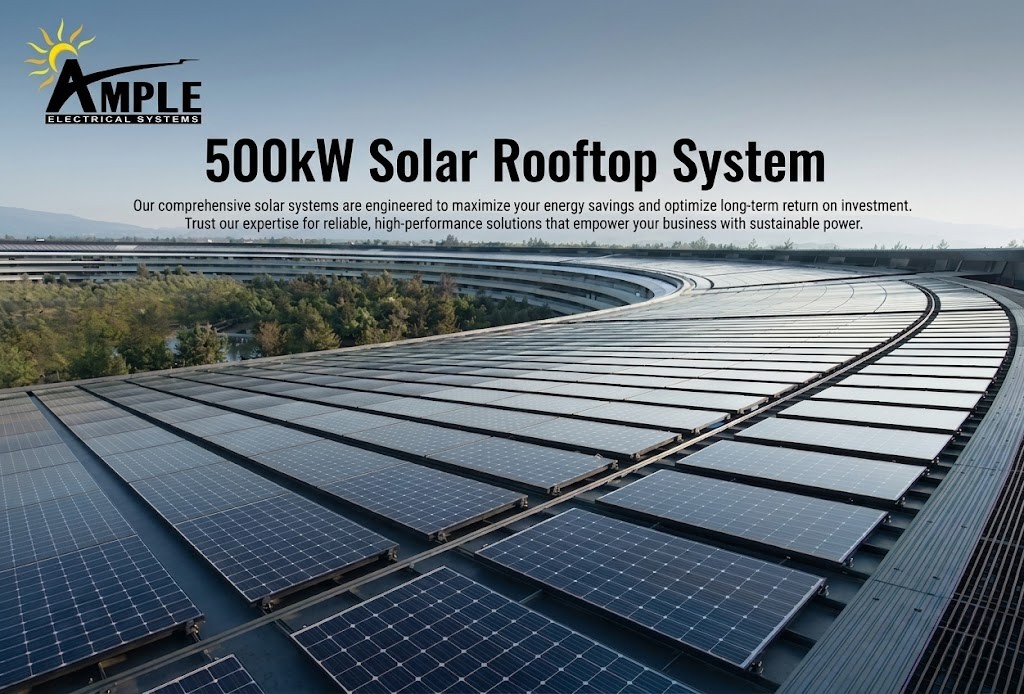
500kW Solar Rooftop System: A Powerful Energy Solution for Large-Scale Businesses
Table of Contents
- Introduction to 500kW Solar Rooftop System
- Key Features of a 500kW Solar Rooftop System
- What is a 500kW Solar Rooftop System?
- How Does a 500kW Solar Rooftop System Work?
- Technical Specifications
- Benefits of a 500kW Solar Rooftop System
- Space Requirement and Energy Generation
- Cost Considerations and ROI
- Installation Process
- Maintenance and Performance Monitoring
- Frequently Asked Questions
- Conclusion
Introduction
ampleelectricals As electricity consumption continues to grow across commercial and industrial sectors, organizations are looking for reliable and cost-effective energy solutions. A 500kW solar rooftop system is designed to meet substantial power requirements while utilizing available rooftop space efficiently.
This system helps businesses generate clean electricity, reduce operational costs, and improve sustainability performance. It is commonly installed in manufacturing units, warehouses, shopping complexes, educational campuses, healthcare facilities, and large corporate buildings.
Key Features
| Feature | Description |
|---|---|
| System Capacity | 500 Kilowatts |
| Suitable For | Commercial & Industrial Facilities |
| Energy Source | Solar Radiation |
| System Life | 25+ Years |
| Maintenance Requirement | Low |
| Monitoring Facility | Real-Time Performance Tracking |
| Grid Connectivity | On-Grid & Hybrid Options |
| Environmental Benefit | Reduced Carbon Footprint |
What is a 500kW Solar Rooftop System?
A 500kW solar rooftop system is a large-capacity solar energy solution installed on building rooftops to generate electricity from sunlight. The system includes solar modules, inverters, mounting structures, electrical protection devices, and monitoring systems.
It is capable of supplying a significant portion of a facility’s electricity demand while helping reduce dependency on conventional power sources.
How Does a 500kW Solar Rooftop System Work?
The system operates through a simple energy conversion process:
- Solar panels capture sunlight.
- Photovoltaic cells convert solar energy into direct current (DC).
- Inverters transform DC into alternating current (AC).
- The generated electricity powers facility operations.
- Excess energy can be exported to the utility grid through net metering, where applicable.
Technical Specifications
| Parameter | Typical Specification |
| Installed Capacity | 500kW |
| Solar Module Type | High-Efficiency Mono PERC |
| Inverter Type | String or Central Inverter |
| Roof Area Required | Approx. 40,000–50,000 sq. ft. |
| System Lifespan | More Than 25 Years |
| Monitoring System | Remote Monitoring Available |
| Grid Integration | Supported |
Benefits of a 500kW Solar Rooftop System
Reduced Energy Expenses
Generating electricity on-site can significantly lower monthly utility bills and operating costs.
Better Utilization of Available Space
Large rooftops can be transformed into productive energy-generating assets.
Long-Term Financial Value
The system provides years of reliable energy production, helping organizations achieve attractive returns on investment.
Sustainability and Environmental Benefits
Solar energy contributes to reduced greenhouse gas emissions and supports corporate sustainability goals.
Protection Against Rising Electricity Costs
Businesses can reduce their dependence on fluctuating utility tariffs through self-generated power.
Space Requirement and Energy Generation
A 500kW installation generally requires approximately 40,000 to 50,000 square feet of shadow-free rooftop area. Actual space requirements may vary depending on panel efficiency and project design.
Energy generation depends on geographic location, sunlight availability, and weather conditions. Proper system design helps maximize performance throughout the year.
Cost Considerations and ROI
Several factors influence project cost:
| Cost Factor | Impact on Project |
| Solar Module Quality | Affects efficiency and lifespan |
| Inverter Selection | Influences system performance |
| Structural Requirements | Depends on the roof condition |
| Electrical Infrastructure | Determines installation complexity |
| Monitoring Features | Enhances performance tracking |
Most organizations achieve long-term savings through reduced electricity consumption and available government incentives.
Installation Process
Site Survey and Assessment
Engineers evaluate roof strength, sunlight exposure, and electrical load requirements.
System Design and Planning
A customized system layout is developed to optimize energy generation.
Equipment Installation
Solar modules, mounting systems, inverters, and electrical components are installed according to industry standards.
Testing and Commissioning
The complete system undergoes performance and safety testing before becoming operational.
Maintenance and Performance Monitoring
Regular maintenance helps maintain system efficiency:
- Periodic panel cleaning
- Monitoring energy generation data
- Inspection of wiring and connections
- Inverter health checks
- Annual preventive maintenance services
Frequently Asked Questions
How much electricity can a 500kW solar rooftop system generate?
Generation depends on location, weather conditions, and system design, but it can produce substantial energy suitable for large commercial and industrial operations.
Is a 500kW system suitable for manufacturing facilities?
Yes, it is widely used by factories, production units, warehouses, and large commercial establishments.
How long does installation take?
Project timelines vary depending on site conditions and approvals, but installation generally takes several weeks.
Does the system require extensive maintenance?
No. Regular cleaning and routine inspections are usually sufficient to maintain performance.
Can excess electricity be supplied to the grid?
Yes, on-grid systems can export surplus energy where net metering regulations permit.
Conclusion
A 500kW solar rooftop system is an effective energy solution for organizations with high electricity consumption. It helps reduce operating costs, improve energy efficiency, and support environmental goals while delivering reliable performance over the long term. With proper planning, professional installation, and routine maintenance, businesses can maximize the benefits of their investment and move toward a more sustainable future.

A Solar Water Pump System is an energy-efficient solution that uses solar power to pump water for agricultural, residential, and commercial applications. It provides a reliable water supply without depending on grid electricity or diesel fuel. Designed for long-term performance, these systems require minimal maintenance and offer a cost-effective, eco-friendly solution for irrigation and water management.
Read more